The Shocking Link Between Mobility Loss and Decline That Nobody's Talking About (And What You Can Do About It)

"I thought my active days were over. My doctor said I'd never walk again. Now I'm doing 5Ks and traveling the world..."

Sponsored by Alinker

January 31, 2026

If you have mobility challenges, you’ve likely been told to "take it easy." To conserve your energy. To sit down when you're tired.


It sounds like compassionate advice. But according to new research in neuroplasticity, it might be the very thing making you weaker.


There is a biological phenomenon called "Neural Pruning," and it explains why people who follow standard medical advice often experience a rapid loss of independence.


If you have felt your world shrinking despite following orders, you are not alone.


Over 20% of North Americans live with mobility challenges. MS, Parkinson's, arthritis, stroke recovery. Different diagnoses, same shrinking world.


But once you understand the link between "resting" and "declining," everything starts to make sense. Including why over 6,500 people worldwide have switched over to something that looks completely different from other mobility devices.


But here's the crazy part.


The people using it aren't just getting around better. They're getting stronger. Going further. Moving faster.


One woman went from barely making it to the supermarket to covering 3.5 kilometers on her first ride.


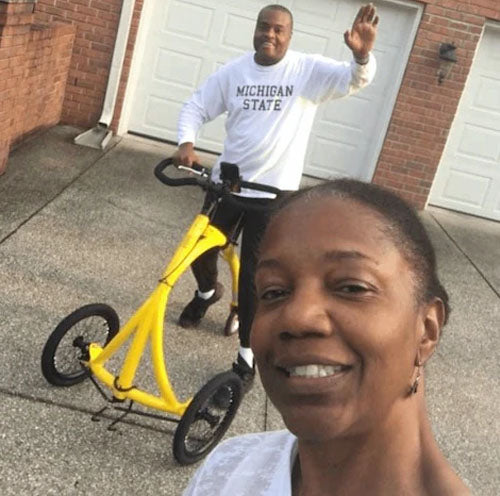
A man whose wife had to help him with everything can now go to the mailbox alone. She has to jog to keep up with him.


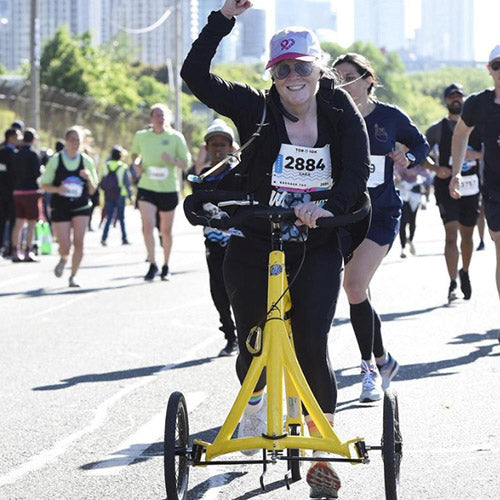
Someone told they'd never walk again is doing 5Ks. 


Here's what's really happening...

The Missing Piece in Traditional Mobility Solutions (That Changes Everything)

Your brain is ruthlessly efficient.


That's usually a good thing. But when it comes to mobility loss, it creates a problem nobody warns you about.


When you start using a wheelchair, your brain notices something. "Oh, we don't need to use the legs anymore. Someone else is handling that."


When you get a motorized scooter, same thing. "Great, we're not coordinating movement or balance. Let's shut those systems down."


Even with walkers, the brain sees you leaning, shuffling, minimizing effort. And it thinks: "These functions aren't needed. Let's turn off those neural pathways to save energy."


This is called neural pruning. It's how the brain stays efficient.


The problem?

Most mobility aids are accidentally signaling to your brain that these muscles are no longer needed. 

Not because the device is bad. But because it's doing exactly what it was designed to do…


Make movement easier by reducing the brain's involvement.

Less effort. Less engagement. Less work.


Which sounds good until you realize what happens next.


Muscles atrophy, balance degrades, and the neural connections that control movement get weaker.


Six months later, you need more help than before. A year later, even more.

This is why people on standard mobility aids often experience what doctors carefully call "accelerated decline."


It's not the disease progressing faster.

It’s a tool designed to conserve energy, which unintentionally encourages the brain to become passive.

Research consistently shows this. Active mobility devices, ones that require you to propel yourself, promote neurological adaptation in ways passive devices simply cannot.


Your brain needs to work to stay engaged.


When it works, it builds new pathways, creates neural connections, and maintains the systems it thinks you're using.


But when it doesn't have to work?


It shuts down.


Lynn L. learned this the hard way.


Diagnosed with Inclusion Body Myositis, she followed every recommendation. Physical therapy. Standard mobility aids. All prescribed exactly as they should be.


And she kept getting weaker.


Her husband was afraid to leave for work, not because of her diagnosis, but because she might fall just trying to move from one room to another.


Then she tried something different. Something that made her brain work instead of rest.


"The Alinker has given me back my strength, my balance, my confidence, my abilities," she said. "My husband can go off to work and know that I'll be safe."

What changed wasn't her diagnosis. It was the tool she was using.

How the Alinker Works (For You)

Step - 1

Your body weight is supported by the saddle. This removes strain from legs and joints, so you won't experience pain or fatigue the way you would standing. In addition, the position of the seat allows you to move onto the Alinker without having to swing your legs over the seat. 

Step - 2

To move forward, you walk your feet. Your legs propel you. Your brain coordinates leg movement, balance, steering, spatial awareness.

Step - 3

The three-wheel design provides stability without requiring constant balance correction. You can stop and rest without tipping over. You can navigate terrain without fear of falling.

Step - 4

The upright positioning keeps you at eye level with everyone around you. Conversations happen naturally. You're visible. Present. Part of the world again.

The standard Lorem

The Social Invisibility Problem Nobody Mentions in the Doctor's Office

Ceilidh C. is an artist, animator, and director.


She uses forearm crutches and has relied on wheelchairs in the past.


She shared, "In a wheelchair, pieces in cases are entirely inaccessible. People hit me in the face with purses, backsides, and backpacks."


But the worst part was being invisible.


"People tend to ignore you if you're not eye-level with them," another user, Judy, explained. "I don't think people ignore you on purpose. They just don't see you."


Think about that for a second.


When you're in a wheelchair, you're positioned below everyone else.


Conversations happen above you. 

Eye contact becomes difficult. 

In crowded spaces, you get bumped, backed into, forgotten.


People talk to whoever's pushing your chair instead of talking to you.


It's not malicious. It's just what happens when you're physically lower than the people around you.


Research in social psychology backs this up. Height affects social dynamics. Being positioned lower during interactions triggers unconscious biases.


People are more likely to dismiss you, interrupt you, and talk over you.


This is the part of mobility loss that doesn't show up on medical charts.


The social erasure, the loss of dignity, and the feeling of becoming a burden instead of a person.


It compounds the physical decline.


Because when you feel invisible, you stop wanting to go places. You avoid social situations. You isolate yourself.


Which leads to depression. Which leads to less movement. Which accelerates the physical decline.


It's a vicious cycle.


But here's what happened when Ceilidh started using The Alinker instead.


"I'm at eye level. I can move from piece to piece in my own timing. People see me as the one on the cool bike."


Not the person in the wheelchair.


Not someone to pity or help or accommodate.


The one on the cool bike.


Valerie from Colorado noticed the same thing:


"I can whiz down the hallway, easily make eye contact again, and I seem to have a permanent smile on my face."


When's the last time you heard someone describe their mobility aid that way?


But you're probably wondering the same thing everyone wonders when they first hear about this.

What Is This Thing and Why Does It Look So Different?

The Alinker was invented by BE Alink, a designer.


Her mother was watching others use walkers. On a walk together in the Netherlands, they passed elderly people with walkers and scooters.


Her mother said something that changed everything:


"Over my dead body will I ever use one of those."


So BE designed something different.


Something that didn't look like a medical device. Something that treated users like whole humans instead of "bodies with problems."


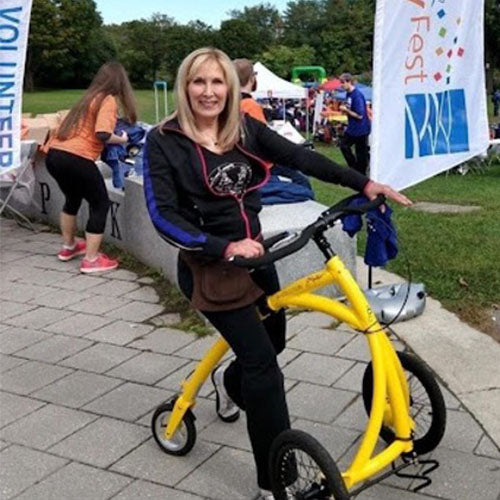
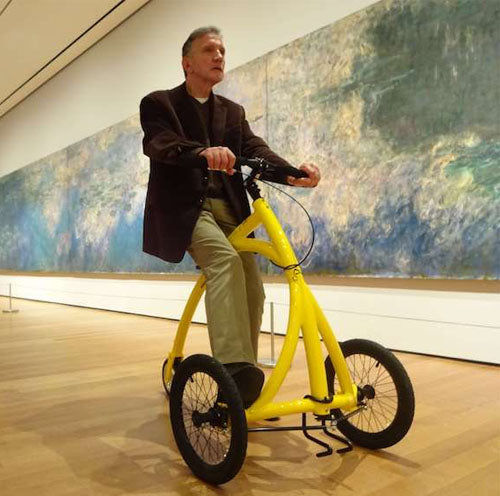
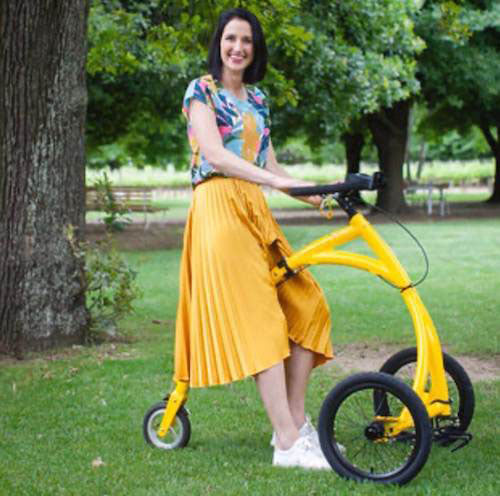
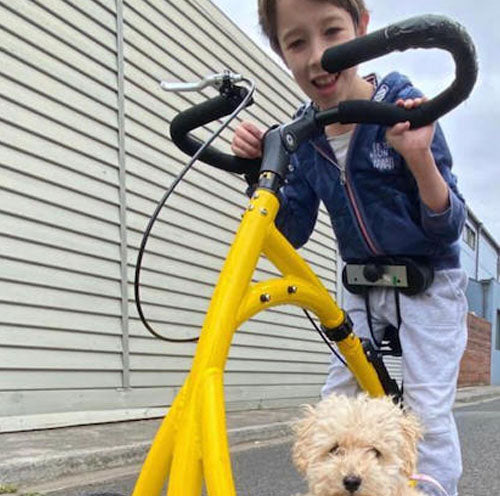
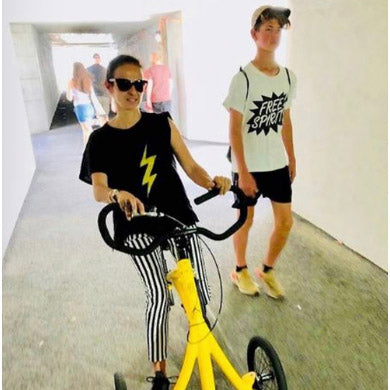
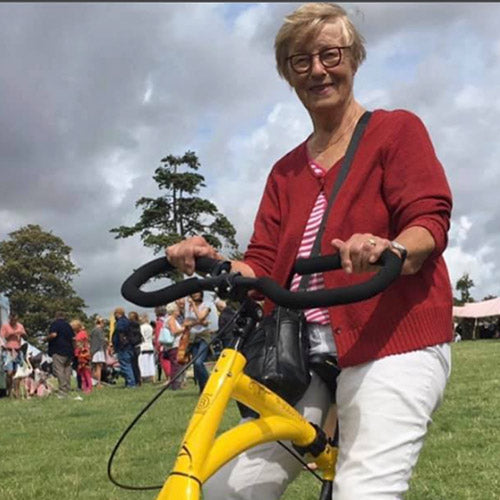
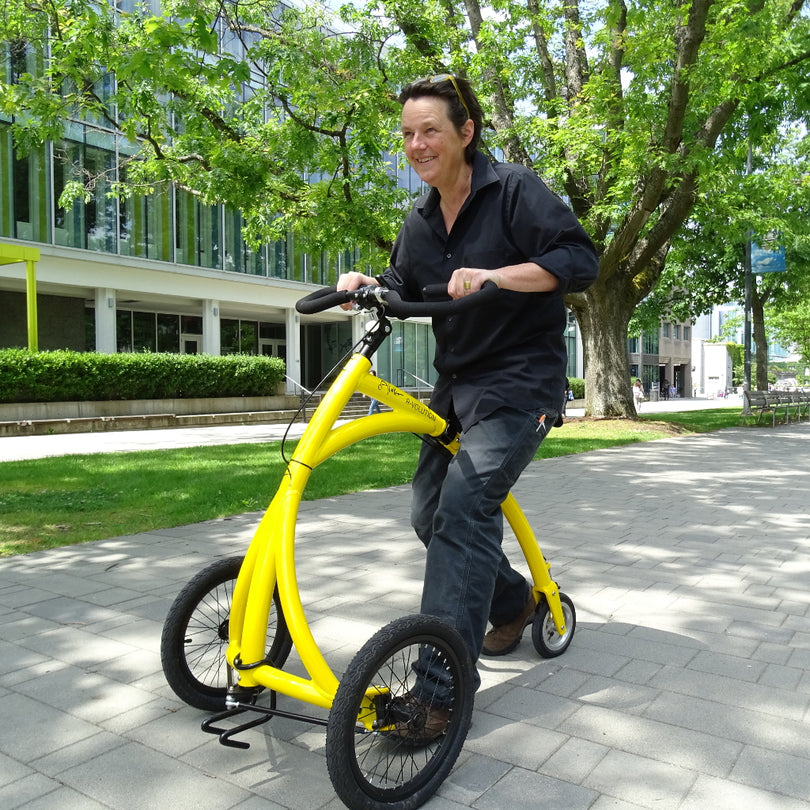
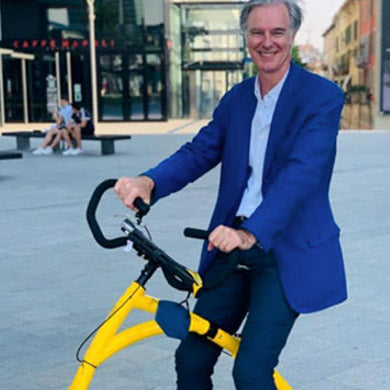
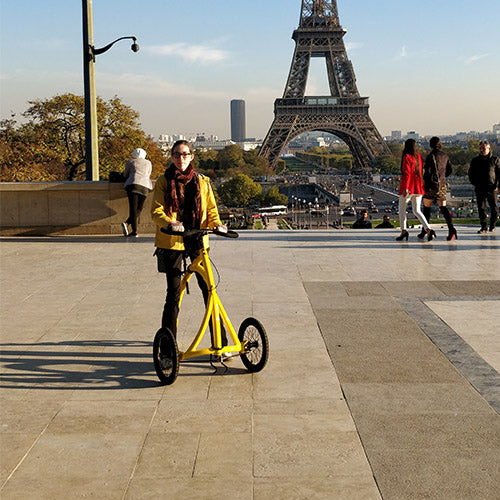
The result? A bright yellow three-wheeled walking bike with no motor and no pedals. Instead, it was the perfect mobility solution for those who want to stay active. 

Here’s what it does: 

Weight Support: The saddle supports your body weight, removing load from legs and joints. No strain. No pain from standing.

Active Propulsion: To move forward, you walk your feet. Your legs push. Your brain coordinates the movement.

Three-Wheel Stability: Unlike bikes that require constant balance, the three-wheel design is stable even when you're not moving. No fear of tipping over.

Eye-Level Positioning: The upright seated position keeps you at the same height as standing people. Conversations happen face-to-face.

Transport Friendly: It folds down quickly to fit in most car trunks, meaning your independence isn’t limited to your neighborhood—you can take it wherever you want to go.

It's designed for people with what The Alinker team calls "an active mindset."


Not people who've given up. Not people looking for the easiest path.


People who understand that effort equals growth. That the brain needs to work to stay engaged. That comfort often leads to decline, not improvement.


On their website, they say: "The Alinker can be hard work, especially when you have lost a lot of your mobility. It takes work and effort, commitment and determination."


Here's why that honesty matters…

When "Hard Work" Becomes the Feature, Not the Bug

Josephine lives in Amsterdam.


Before The Alinker, she was "lucky if my bad leg could manage a few hundred meters walk down to the supermarket."


Standard mobility aids helped her get around. But they didn't help her improve.

Then she tried The Alinker.


First ride? She covered 3.5 kilometers.


"I was absolutely astonished that I'd covered that much ground. And I still had energy left."


But it gets better.


"By pushing off with my good leg I can pick up some speed. For the first time in years my friends and family have told me to slow down."


Read that again.


Her friends and family had to tell her to slow down.


When's the last time someone with mobility challenges got that feedback?

This is what happens when the tool makes your brain work instead of doing the work for you.


Leon has Parkinson's. His wife wrote this:


"He is loving it and is going off on his own to our local mailboxes, once around the block. It is giving him a freedom he has not had in a while. He can get some pretty good speed going, to the effect that I have to speed walk or jog to keep up with him."


Then she added, "It has been a long time since he was faster than I am."


Think about what that means for their relationship. For Leon's sense of self. For his independence.


Sergio had doctors tell him he'd never walk again. Now, "I travel the world again…unimaginable without the Alinker."


One spouse wrote, "Yesterday I was able to walk beside my awesome husband for the first time in 6 years."


Six years of being unable to walk side by side. Then suddenly, they could.

The difference wasn't a new medication. Not surgery. Not some experimental treatment.


The difference was a tool that activated their brains instead of letting them rest.

How Does It Actually Work?

The Alinker uses a principle that's almost too simple.


Your brain wants to work. It just needs something to work on.


Standard mobility aids remove that challenge. They eliminate effort. Make things passive.


The Alinker does the opposite.


This constant engagement, the active propulsion, the balance coordination, and the spatial awareness activate neuroplasticity.


That's the brain's ability to form new neural connections and reorganize existing ones.


Active mobility devices promote neurological adaptation in ways passive devices cannot.


When your brain has to work, it builds new pathways. Strengthens existing ones. Maintains the systems it thinks you're using.


This doesn't cure the underlying condition.


But it can dramatically change the trajectory.


From declining to maintaining and from maintaining to improving.


Users report muscle mass returning, balance improving, and even pain levels decreasing.


Not because the disease went away. But because the brain got the challenge it needed to stay engaged.

Who This Is Actually For (And Who It's Not For)

The Alinker team is surprisingly specific about this.


They provide minimum physical requirements:

  • Some command over your legs
  • Ability to lift one leg while standing on the other
  • Awareness of your surroundings
  • Ability to make judgment calls about your own abilities

But beyond physical requirements, there's a mindset component.


This is for people who:

  • Identify as active individuals who happen to have mobility challenges
  • Understand that comfort often leads to decline, not improvement
  • Are willing to work through initial discomfort for long-term gains
  • Want to be engaged and visible, not passive and invisible
  • Refuse to accept that decline is inevitable

It's NOT for people who:

  • Want the easiest possible solution with minimal effort
  • Expect instant results on day one
  • Have completely lost leg function
  • People who cannot support their own weight while sitting or standing on one leg.

The Alinker is used by people with MS, Parkinson's, arthritis, stroke recovery, spinal cord injuries, muscular dystrophy, CMT, and dozens of other conditions.

What unites them isn't the diagnosis.


It's the refusal to accept that their active days are over.

What People Love About It (Beyond Just Getting Around)

It's Fast, Easy to Use, No Prescription Required

Thanks to the simple design, you can start using it right out of the box. Adjust the seat height, grab the handlebars, and go. No doctor visits. No prescriptions. No complicated setup.


It Keeps You at Eye Level

It's about being seen. Making eye contact. Having conversations face-to-face. Being part of the world instead of watching from below.


It Makes Your Brain Work

The active propulsion means your brain stays engaged. Neural pathways stay active. Muscles stay challenged. This is the opposite of passive assistance.


It's Stable and Safe

The three-wheel design means no fear of tipping over. You can stop and rest without losing balance. Navigate uneven terrain without anxiety.


It's Adjustable to Your Body

Comes in three sizes to accommodate heights from 5'4" to 6'3". Seat and handlebars adjust for comfort. It fits you, not the other way around.


People Ask About It (In a Good Way)

Multiple users mention this. Strangers approach with genuine curiosity. "What is that cool bike?" Not awkward stares. Not pity. Actual interest.

Real Reviews From Real People

⭐⭐⭐⭐⭐
 "Before getting my Alinker, I was lucky if my bad leg could manage a few hundred meters walk down to the supermarket. When I took my Alinker on its maiden voyage to the local park I 'walked' 3.5 km (!). I was absolutely astonished that I'd covered that much ground. And I still had energy left. For the first time in years my friends and family have told me to slow down. I love it." - Josephine R., Amsterdam


⭐⭐⭐⭐⭐
 "He is loving it and is going off on his own to our local mailboxes—once around the block. He can get some pretty good speed going, to the effect that I have to speed walk or jog to keep up with him. It has been a long time since he was faster than I am. People in our neighborhood think it is a very cool 'walking bike' and can see how much he enjoys using it." - Leon's wife


⭐⭐⭐⭐⭐
 "The Alinker has given me back my strength, my balance, my confidence, my abilities. My husband can go off to work and know that he can leave me and I'll be safe." - Lynn L., Inclusion Body Myositis


⭐⭐⭐⭐⭐
 "I avoided going outside for a year because the memory of how hard concrete is to fall on is still fresh in my mind. Now with The Alinker I can whiz down the hallway, easily make eye contact again, and I seem to have a permanent smile on my face. My brain feels so relieved not having to stress about tripping and falling." - Valerie K., Colorado


⭐⭐⭐⭐⭐
 "I'm an artist, performer, writer, director, and animator. I'm also disabled. Now I have my Alinker that I use at all the cultural institutions and museums. It has enabled me to finally see exhibits as they should be seen—at eye level. In a wheelchair, people hit me in the face with purses and backpacks. On The Alinker, people see me as the one on the cool bike." - Ceilidh C., Artist


⭐⭐⭐⭐⭐
 "Doctors told me I would never walk again. They were very definite about it. Now I travel the world again—unimaginable without the Alinker." - Sergio P., Stroke Recovery


⭐⭐⭐⭐⭐
 "Yesterday I was able to walk beside my awesome husband for the first time in 6 years. (Let's soak this in.) You see, because he uses a walker and a cane to walk, it's extremely hard for him to keep his balance next to a person. The Alinker changed that." - Anonymous Spouse

The Investment Question Everyone Has

Let's address the obvious.


The Alinker costs $2,830 brand-new. 


Standard insurance doesn't usually cover it because it's classified as adaptive sports equipment, not a medical device.


So why do people pay for it?


One user explained it this way, "Less than $3,000 for accessibility in the world is peanuts."


If you continue with standard mobility aids, what happens over the next five years?


Muscle loss continues. Balance degrades. You need more physical therapy. More doctor visits. Eventually, home health assistance for daily activities.


The medical expenses compound. The personal care costs add up. The loss of independence becomes complete.


One path costs less than $3,000 upfront and leads to improvement.


The other path seems cheaper at first but leads to tens of thousands in ongoing costs and complete dependency.


Multiple Alinker users report reduced medical expenses after a few months of use.


Less physical therapy needed. Fewer doctor visits. Lower medication requirements. Decreased personal care expenses.


Plus, the company offers options to make it more accessible:


Rent-to-Own Program (0% Interest):
Pay a down payment, rent for 4 months, then pay off the balance over 8 months. Own it within a year for the same total price. No interest.


Crowdfunding Support:
The Alinker team helps users set up crowdfunding campaigns. As they put it: "Together we show up for each other, and then no one is left behind."


15-Day Trial Period:
Try it. If it doesn't work for your specific situation, return it for a full refund. No questions asked.


The real question isn't "Can I afford The Alinker?"


The real question is: "What's the cost of staying on my current trajectory?"

What Happens Next

You're at a decision point.


You've seen the research. You've read the testimonials. You understand the principle.


Your brain needs to work to stay engaged. Passive assistance leads to decline. Active engagement leads to improvement.


Now you have to decide.


Path A: Continue with standard mobility aids. They're familiar, covered by insurance, and recommended by most doctors. They help you manage the situation as it is.


Path B: Try something designed for people who refuse to accept that decline is inevitable. Something that makes your brain work. Something that keeps you visible and engaged at eye level with the world.


Path A is perfectly valid. Standard mobility aids serve an important purpose and help millions of people manage their conditions safely. There is nothing wrong with this route. 


But if you're someone with an active mindset, someone willing to do the work to get stronger, Path B is opening up possibilities that seemed impossible.


Josephine went from a few hundred meters to 3.5 kilometers. On her first ride.

Leon is faster than his wife for the first time in years.


Sarah is completing 5Ks she thought were gone forever.


Lynn's husband can leave for work without worrying she'll fall.


One spouse walked beside their partner for the first time in six years.


Valerie has a permanent smile on her face.


Ceilidh is the one on the cool bike, not the invisible person in the wheelchair.


These aren't miracles. They're what happens when the brain gets the right challenge.


For people ready to explore whether this approach fits their situation:


✓ Check current availability
✓ Explore rent-to-own options (0% interest)
✓ Review the 15-day trial policy
✓ Contact customer service with questions about sizing


This isn't for everyone. But for people who identify as active individuals who happen to have mobility challenges, people willing to work for their independence back, it might be exactly what's been missing.


One user said it best:


"I thought I knew what was possible with my condition. Turns out, I was wrong."

Own Your Movement


YES! I Want to Check Availability & Explore Options

Alt image Alt image Alt image

The Alinker

Different sizes available. 

CHECK AVAILABILITY

Remember...

It's not just about getting from point A to point B...

It's about reconnecting your brain to your body.

It's about rejecting the idea that "decline" is inevitable.

It's about embracing the confidence that comes from being at eye level. Feeling utterly independent, moving under your own power, and radiating the energy of someone who is active, visible, and engaged in the world.

No motors doing the work for you...

No pedals...

No limits!

Limited time offer! Check availability and claim your Free Shipping before the current stock runs out.


*The Alinker is designed for people with an active mindset who are willing to work for their independence. It is not a medical device and should not replace medical advice. Consult with healthcare providers before beginning any new mobility program. Individual results vary. 

ADVERTISING DISCLOSURE: This website and the products & services referred to on the site are strictly for promotional purposes. This is an advertisement and not a news publication.

TESTIMONIAL DISCLOSURE: The testimonials presented on this site are applicable to the individuals depicted. Results will vary and may not be representative of the experience of others. The testimonials are voluntarily provided and are not paid, nor were they provided with free products, services, or any benefits in exchange for said statements.

MEDICAL DISCLOSURE: The Alinker is a non-motorized walking bike designed for people with an active mindset. It is not a medical device and is not intended to diagnose, treat, cure, or prevent any disease. Always consult with your healthcare provider before beginning any new mobility program.

Copyright © 2024. All Rights Reserved.

Title

Worldwide shipping

Contact our distributors to see about shipping to your region - International Distribution Partners